TEL: +86-750-6896682 Email:info@goodtissue.com

 English
Views: 0 Author: Site Editor Publish Time: 2026-09-26 Origin: Site


Sourcing kitchen paper towels in bulk isn't as simple as picking the softest roll off a supermarket shelf. B2B buyers—whether they're stocking hotel kitchens, supplying restaurant chains, or building a private-label brand—need to navigate ply counts, absorbency ratings, minimum order quantities, and factory certifications before a single container ships. Get it wrong, and you're stuck with excess inventory that doesn't meet your customers' expectations or, worse, a batch that fails basic quality checks.
China remains the dominant hub for tissue and paper towel manufacturing, thanks to established supply chains, competitive raw material pricing, and decades of export experience. But not every wholesale tissue factory offers the same level of quality, customization, or reliability. This guide breaks down what buyers actually need to know when sourcing kitchen paper towel and kitchen paper products from Chinese manufacturers, so you can make an informed purchasing decision instead of a costly guess.
China's paper manufacturing sector has matured into a highly specialized industry. Many facilities operate as a dedicated wholesale tissue factory, meaning their entire production line—from pulping to converting to packaging—is optimized for bulk B2B orders rather than small retail runs.
This specialization brings several advantages to international buyers:
Scale and efficiency: Large manufacturing plants can produce high volumes without the price premiums associated with smaller-batch production.
OEM/ODM flexibility: Many factories support custom branding, packaging, and product specifications, which is essential for private-label buyers.
Established export infrastructure: Decades of shipping to Europe, North America, South America, and Oceania mean most established factories have logistics and documentation processes already in place.
Raw material access: Proximity to pulp suppliers and integrated production reduces costs that would otherwise be passed on to buyers.
Take Jiangmen Yafeng Paper Industry as an example. Established in 2001, the company operates a roughly 30,000-square-meter manufacturing plant and has exported household paper products—including kitchen paper, facial tissue, and toilet paper—to markets across Europe, South-East Asia, North America, South America, and Oceania. Factories with this kind of export history tend to have already solved the compliance and logistics headaches that trip up newer suppliers.
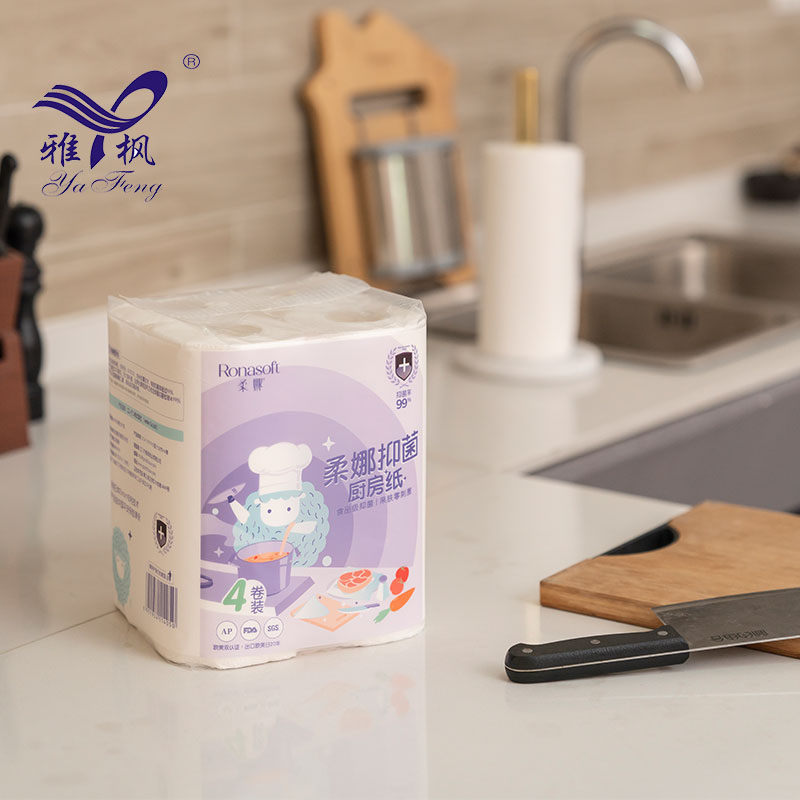
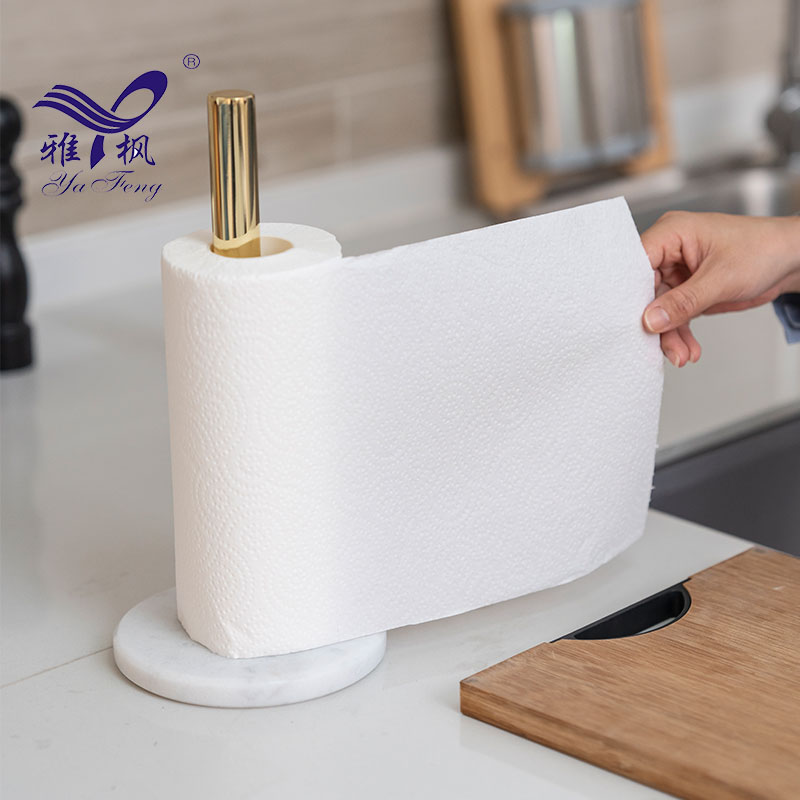
Not all kitchen paper towel products are built the same, even if they look similar on a spec sheet. Buyers should evaluate a few core factors before committing to an order.
Ask whether the kitchen paper towel is made from virgin wood pulp or recycled fiber. Virgin pulp typically delivers better softness, strength, and absorbency, which matters for commercial kitchens that need towels to hold up under repeated spills and wipe-downs. Some manufacturers, like Yafeng, use 100% virgin wood pulp sourced from FSC-certified, responsibly managed forests, which is worth confirming if sustainability credentials matter to your end customers.
Kitchen paper is commonly available in 2-ply, 3-ply, and 4-ply configurations. Higher ply counts generally mean better absorbency and durability, but they also affect cost and shipping weight. Buyers should match ply count to actual use case rather than defaulting to the highest option available.
FSC certification confirms that wood pulp originates from responsibly managed forests. This matters not just for sustainability positioning, but increasingly as a requirement for buyers selling into markets with strict environmental sourcing standards.
If you're building a private-label product line, confirm the factory can handle custom logo printing, packaging design, and product specifications. Established factories often have design teams that can collaborate on new concepts, which reduces the need to manage a separate design agency.
Every factory sets its own MOQ and production timeline. Buyers should request this information upfront and compare it against their own inventory planning needs, since a mismatch here can create cash flow strain or stockouts.
Below is a quick reference table summarizing the key criteria buyers should evaluate during supplier comparison.
Criteria | Why It Matters | Questions to Ask the Supplier |
|---|---|---|
Raw material (virgin vs. recycled pulp) | Impacts softness, strength, and absorbency | Is the pulp 100% virgin wood pulp? |
Ply count | Affects durability and cost per unit | What ply options are available for kitchen paper towel products? |
Certifications (FSC, etc.) | Confirms sustainable sourcing | Can you provide FSC certification documentation? |
OEM/ODM support | Enables private-label branding | Do you offer custom packaging and logo printing? |
MOQ | Determines order flexibility | What is the minimum order for a first-time buyer? |
Export experience | Reduces shipping and compliance risk | Which markets have you exported to previously? |
Production capacity | Affects ability to scale with demand | What is your monthly production volume for kitchen paper? |
Due diligence matters more when sourcing internationally, simply because site visits and in-person meetings aren't always practical. A few practical steps can reduce risk considerably.
Request samples before placing a bulk order. No spec sheet substitutes for physically testing absorbency, tensile strength, and softness. A reputable wholesale tissue factory will typically send samples without hesitation.
Check trade show history. Manufacturers that regularly exhibit at events like the Canton Fair or international trade expos tend to have export experience and are accustomed to working with overseas buyers. Yafeng Paper, for instance, has exhibited at events including the 137th Canton Fair and has upcoming participation at the China (Poland) Export Brand Exhibition in Warsaw—details available on the company's news page.
Verify factory size and production capacity. A manufacturer's facility size is often a reasonable proxy for its ability to fulfill large, recurring orders without delays.
Ask about quality control processes. Reliable suppliers should be able to describe their quality assurance steps clearly, not vaguely. If a supplier can't explain how they test for absorbency or tensile strength, treat that as a red flag.
Kitchen paper towels come in several formats, and choosing the right one depends on the end-use environment:
Roll format: Best suited for high-volume commercial kitchens where quick tear-off convenience matters more than portion control.
Folded/sheet format: Useful for dispensers in shared kitchen or prep areas where controlled usage helps manage costs.
Reusable/washable paper towels: A newer category gaining traction with buyers focused on sustainability, offering multiple uses before disposal.
Choose roll format if your buyers prioritize speed and volume over cost control. Choose folded or dispensed formats if portion control and reduced waste are the priority, such as in shared office kitchens.
Sourcing wholesale kitchen paper towel products from a Chinese manufacturer comes down to matching your buyer requirements—material quality, certifications, MOQ, and customization needs—against a factory's actual capabilities. Established manufacturers with export track records, visible trade show participation, and OEM/ODM support tend to reduce the guesswork considerably.
If you're evaluating suppliers, start by requesting samples and certification documentation, then compare lead times and MOQs against your own demand forecasts. Manufacturers like Yafeng Paper Industry publish detailed product catalogs and maintain an active news presence, which can give buyers a clearer picture of production capacity and export experience before committing to a purchase order.
What is the typical MOQ for wholesale kitchen paper towel orders from Chinese factories?
MOQs vary by manufacturer and product specification, often depending on ply count, packaging customization, and container size. Buyers should request MOQ details directly from the supplier, as it can differ significantly between standard and custom-branded orders.
Is virgin wood pulp better than recycled pulp for kitchen paper?
Virgin wood pulp generally offers superior softness, strength, and absorbency compared to recycled fiber, making it a common choice for commercial-grade kitchen paper towel products where performance under repeated use matters.
How can I verify a Chinese tissue factory's export experience?
Look for evidence of trade show participation, published case studies, and export history to specific regions. Checking a manufacturer's news updates or press releases can offer useful insight into their international activity.
Can Chinese manufacturers produce private-label kitchen paper towels?
Many wholesale tissue factories offer OEM and ODM services, including custom packaging, logo printing, and product specification adjustments to support private-label branding.
What certifications should I look for when sourcing kitchen paper?
FSC certification is one of the most relevant credentials, confirming that wood pulp is sourced from responsibly managed forests. This is particularly important for buyers with sustainability commitments or customers who prioritize eco-conscious products.


